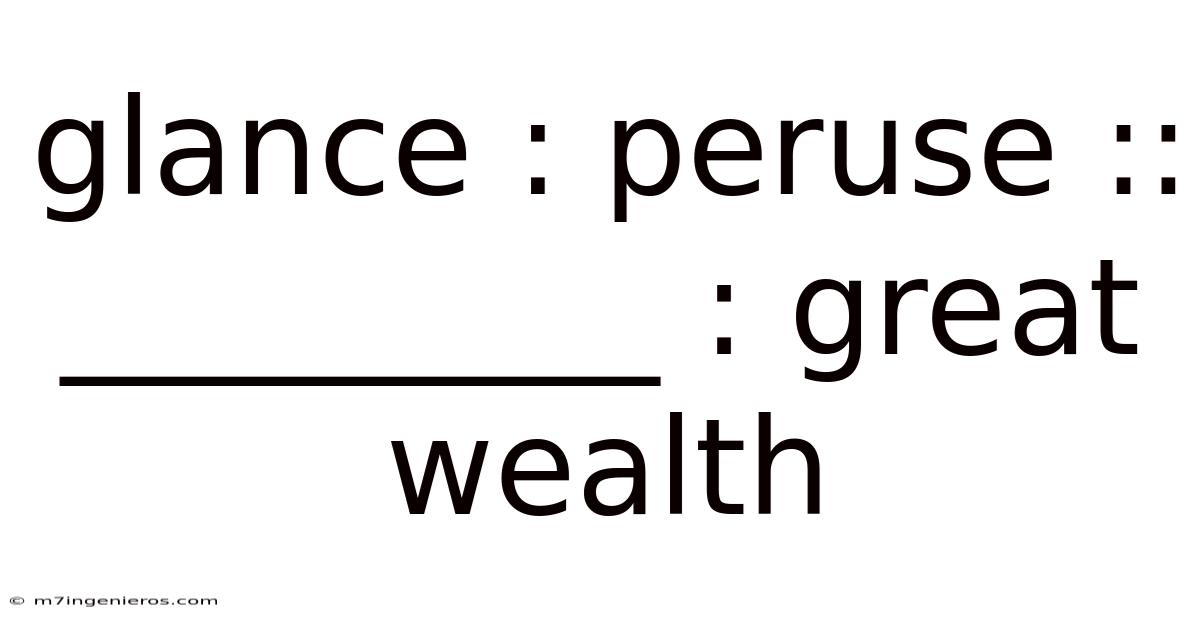
Understanding word relationships is a cornerstone of verbal reasoning, a skill tested rigorously in standardized exams like the GRE, SAT, MAT, and various civil service assessments. So among the most common question types is the analogy, which requires the test-taker to identify a specific semantic relationship between a pair of words and then apply that same relationship to a new pair. A classic example that frequently appears in study guides and practice tests is: glance : peruse :: _________ : great wealth That's the part that actually makes a difference. That alone is useful..
Solving this requires more than just vocabulary knowledge; it demands an understanding of degree of intensity. This article provides a comprehensive breakdown of this specific analogy, explores the linguistic principles behind it, offers strategies for solving similar problems, and expands on the vocabulary necessary to master "degree" analogies.
Honestly, this part trips people up more than it should That's the part that actually makes a difference..
Decoding the Core Relationship: Intensity and Degree
Before filling in the blank, we must define the relationship between the stem words: glance and peruse.
- Glance (verb/noun): To look quickly or briefly; a swift, often superficial act of seeing.
- Peruse (verb): To read or examine something thoroughly and carefully. Note: In modern casual usage, "peruse" is sometimes used to mean "skim," but in formal testing contexts and traditional definitions, it implies deep, careful study.
The Relationship: Low Intensity : High Intensity (or Superficial : Thorough).
A glance represents the minimal possible effort or duration applied to the act of looking. But Peruse represents the maximal, most intensive effort applied to that same act. They are not opposites (antonyms); rather, they exist on the same spectrum of visual scrutiny, separated by a vast distance of intensity Most people skip this — try not to..
Which means, the analogy structure is:
Minimal Degree of Action X : Maximal Degree of Action X :: Minimal Degree of Concept Y : Maximal Degree of Concept Y
Solving the Target Analogy: The Missing Term
The second half of the analogy presents the "Maximal Degree" term first: great wealth Still holds up..
- Great wealth signifies a massive, abundant, maximal amount of money or resources.
To complete the analogy correctly, we need a word that signifies the minimal degree of wealth—a very small, insufficient, or meager amount.
The precise answer is: Pittance And that's really what it comes down to..
Complete Analogy: Glance : Peruse :: Pittance : Great Wealth
Why "Pittance" is the Perfect Fit
A pittance is defined as a very small or inadequate amount of money paid to someone as an allowance or wage. It carries a connotation of insignificance relative to the effort expended or the need required, perfectly mirroring the relationship between a glance (insignificant effort) and peruse (maximal effort).
Let’s test the relationship:
- A glance is to looking what a pittance is to wealth.
- Both pairs represent the extreme ends of a quantitative spectrum.
Distractors: Why Other Words Fail
In a multiple-choice setting, several tempting distractors (wrong answers) might appear. Understanding why they are incorrect sharpens analytical skills Which is the point..
| Distractor | Definition | Why It Fails the Analogy |
|---|---|---|
| Fortune | A large amount of wealth. In real terms, * "Modicum" is neutral (e. One can have great wealth and great debt simultaneously. In practice, | |
| Poverty | The state of being extremely poor. , "a modicum of respect"). It creates a Synonym : Synonym relationship, breaking the Degree pattern. | This is a related concept (association), not a degree of wealth itself. Worth adding: |
| Modicum | A small quantity of something. "Pittance" specifically denotes money/wealth and implies insufficiency, making it the tighter semantic fit for the "wealth" domain. | |
| Trifle | A thing of little value or importance. g.And | |
| Debt | Money owed. Also, | This is a synonym for great wealth, not the minimal degree. Glance is not the opposite of peruse; it is a lesser version of the same action. "Pittance" is domain-specific to finance/wages. |
The Taxonomy of Analogy Relationships
To master analogies, one must categorize the relationship instantly. The glance : peruse pair falls under the Degree of Intensity category (sometimes called "Order of Magnitude"). Here are the other major categories frequently tested:
- Synonym / Definition: Benevolent : Kind
- Antonym / Contrast: Miserly : Generous
- Part to Whole: Engine : Car
- Whole to Part: Library : Book
- Cause and Effect: Virus : Illness
- Tool and User: Scalpel : Surgeon
- Tool and Function: Thermometer : Temperature
- Worker and Product: Poet : Sonnet
- Classification / Category: Robin : Bird
- Degree of Intensity: Drizzle : Downpour :: Annoyed : Furious (This is our target category).
Pro Tip: When you see a stem pair where one word seems like a "stronger" version of the other (e.g., like : love, warm : scalding, error : blunder), immediately classify it as Degree of Intensity. The answer pair must reflect that same scalar jump Small thing, real impact. Nothing fancy..
Deep Dive: The Etymology and Nuance of "Pittance"
Understanding the history of a word cements its meaning far better than rote memorization.
Pittance originates from the Medieval Latin pietantia, derived from pietas (piety, pity, compassion) Simple as that..
- Historical Context: In medieval monasteries, a pittance was a small charitable allowance of food or money given to monks or the poor on special occasions (pittance days) as an act of piety.
- Semantic Shift: Over centuries, the religious connotation faded, leaving the core meaning: a minimal, often grudging or insufficient allowance.
This etymology reinforces the "Degree" relationship. A pittance is not just "a little money"; it is money given in a token amount—barely enough to survive—just as a glance is barely enough to see.
Deep Dive: The Controversy of "Peruse"
No discussion of this analogy is complete without addressing the word peruse.
- Traditional/Formal Definition (Testing Standard): To read thoroughly, examine in detail, study carefully. *Origin: Middle English perusen (to use up, wear out), implying reading
The Controversy of “Peruse”
The word peruse has long been a thorn in the side of both lexicographers and test‑preppers. Its modern footprint is split between two competing senses:
| Sense | Core Meaning | Typical Register | Example |
|---|---|---|---|
| **1. Day to day, ” | Informal speech, casual writing. | “The professor asked the class to peruse the assigned chapter before the discussion.But ” | |
| 2. Because of that, colloquial/Reduced | To read quickly or superficially; often synonymous with “skim. | Academic, literary, formal writing. Even so, formal/Traditional** | To read thoroughly and attentively; to study in detail. |
The etymological root—perusen (Middle English), meaning “to use up, wear out”—originally implied exhaustive consumption, which aligns with the traditional sense. Even so, the reduced sense emerged in the 20th century, likely driven by a pragmatic need for a more vigorous verb to replace “read” when the act is cursory Simple as that..
Most guides skip this. Don't.
Why the split matters for analogies
In analogy questions, the test‑maker assumes the standard definition unless the surrounding context explicitly signals a different usage. Because of this, the pair glance : peruse is interpreted as “a fleeting look” versus “a careful, in‑depth examination.” Even if a test‑taker is familiar with the colloquial shorthand, the answer must reflect the stronger meaning of “peruse” to preserve the degree‑of‑intensity relationship.
Applying the “Degree of Intensity” Framework
When you encounter a stem pair, ask yourself:
-
Is one word a more extreme version of the other?
- Glance → a brief, almost accidental visual contact.
- Peruse → a deliberate, thorough visual (or textual) engagement.
-
Does the relationship map onto the “Degree of Intensity” category?
- Yes. The jump from “glance” to “peruse” mirrors the jump from “pittance” (a token, insufficient amount) to “wealth” (a substantial, sufficient amount).
-
Is there any contextual clue that would shift the meaning?
- If the sentence reads, “She perused the headlines quickly,” the reduced sense is intended, but the analogy still expects the stronger sense unless the analogy itself is built around that reduced usage.
Quick‑fire tip: In standardized analogy sections, default to the formal definition of ambiguous verbs like “peruse,” “commence,” or “descend.” The test designers rarely intend to exploit contemporary slang; they aim to assess your grasp of the word’s core semantic weight.
Recap of the Taxonomy (Focused on Degree of Intensity)
| Category | Example Pair | Core Idea |
|---|---|---|
| Synonym / Definition | Benevolent : Kind | Same meaning, different phrasing. On top of that, |
| Part to Whole | Engine : Car | Component → system. |
| Worker and Product | Poet : Sonnet | Creator → creation. |
| Tool and User | Scalpel : Surgeon | Instrument → operator. |
| Tool and Function | Thermometer : Temperature | Device → what it measures. Consider this: |
| Cause and Effect | Virus : Illness | Trigger → outcome. In real terms, |
| Whole to Part | Library : Book | System → component. |
| Antonym / Contrast | Miserly : Generous | Opposite ends of a moral spectrum. But |
| Classification / Category | Robin : Bird | Specific → broader class. |
| Degree of Intensity | Glance : Peruse | Minimal → maximal within a single domain. |
Final Takeaway
Mastering analogies is less about memorizing endless word lists and more about recognizing the relationship that binds two terms. The Degree of Intensity category is a powerful shortcut: whenever you see a pair where one word clearly amplifies the other—whether it’s glance amplified to peruse or pittance amplified to wealth—you can instantly label the relationship and select an answer that preserves
This principle extends to a wide array of semantic fields. That said, in the realm of cognition, doubt escalates to certainty, representing opposite poles of mental conviction. Consider the relationship between murmur and shout, where the latter is simply the former amplified to its maximum volume. Even in the physical world, drizzle intensifies to torrent, both forms of precipitation but on a vastly different scale of force That alone is useful..
By internalizing this category, you transform analogy-solving from a guessing game into a logical deduction. You are no longer merely matching words; you are identifying the specific type of connection that binds them. When faced with a challenging pair, ask yourself if the relationship is one of simple comparison, opposition, or, most powerfully, a matter of degree. If the latter, you have found your anchor.
Pulling it all together, the true mastery of analogies lies in this precise relational mapping. Here's the thing — the "Degree of Intensity" framework serves as a critical lens, allowing you to decode pairs like glance and peruse by recognizing the fundamental principle of escalation. This analytical approach, grounded in understanding the core semantic relationship, is the key to unlocking even the most complex analogy questions with confidence and clarity.
